
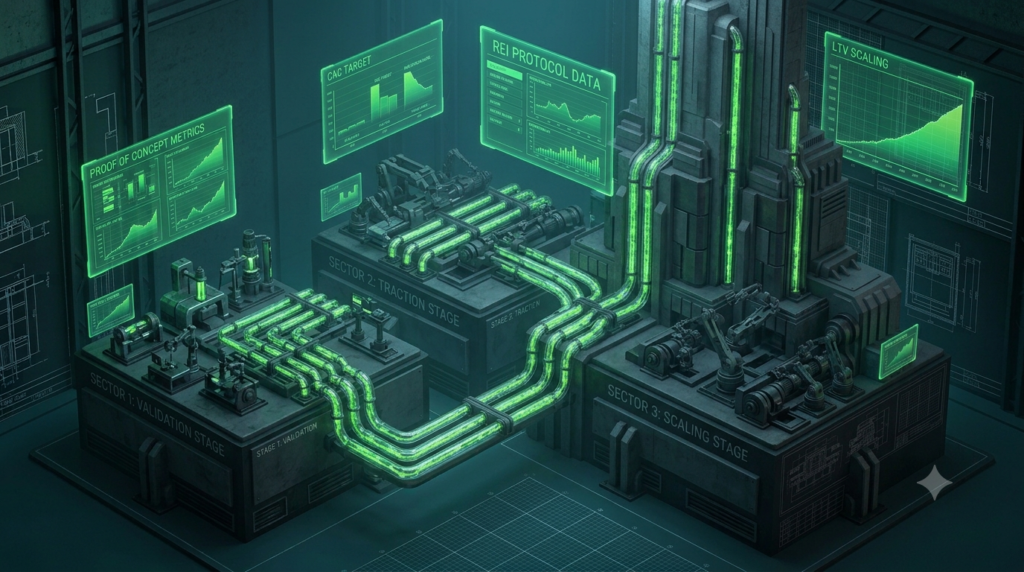
In most B2B and high-value service organizations, growth is managed as a series of fragmented departments. Marketing is responsible for generating prospects, Sales tries to close them in the CRM, and Operations focuses on retaining them.
This disconnect creates one of the most costly problems for companies in the scaling stage: the gap between customer acquisition investment and the actual return generated in cash. The reason is simple: treating revenue as solely a "marketing" problem is a diagnostic error.
Traditional agencies focus exclusively on the surface—campaigns, clicks, or lead generation—while ignoring what happens throughout the rest of the process. Revenue Engineering emerges to solve this disconnect by recognizing that revenue is not the result of isolated tactics, but rather the product of an integrated commercial infrastructure .
Revenue Engineering as an Industrial Process
To understand Revenue Engineering, we must apply the perspective of industrial engineering to a company's commercial architecture.
From a process engineering perspective, a commercial system is defined as a structured flow that transforms inputs into a high-value outcome.
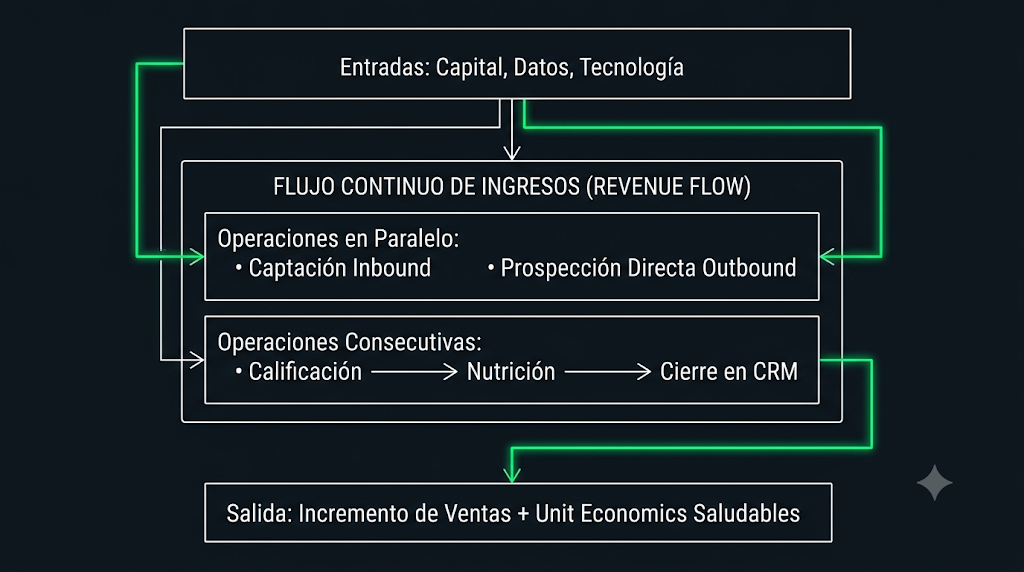
A Revenue Engineering process consists of four fundamental dimensions:
1. The Commercial Flow (Start to Finish)
The flow does not end when a prospect completes a form, nor does it end when they sign a contract. It is a continuous cycle that begins at the first point of contact with a stranger and extends through conversion, retention, and churn prevention. Designing the flow from end to end makes it possible to identify exactly where friction occurs or where capital is lost.
2. Input Resources
These are the inputs that feed the commercial engine:
- Financial capital invested in customer acquisition.
- Market data and customer segmentation.
- Technology stack (CRM, automation platforms, analytics).
- Human talent and operational time.
3. Sequential and Parallel Operations
A revenue engine executes tasks according to process engineering logic:
- Sequential Operations: Linear sequences in which each stage depends on the previous one. For example: Qualified Lead ➔ Technical Demonstration ➔ Proposal Evaluation in the CRM ➔ Contract Signing..
- Parallel Operations: Processes that occur simultaneously to optimize the use of time. For example, while Inbound campaigns educate the audience about the value proposition, Direct Outbound prospecting systems validate new market segments.
4. Output Resources and Added Value
The objective of every industrial process is to create value. In Revenue Engineering, the output is not simply "traffic" or "contact volume," but sustained sales growth through the generation of high-quality prospects, acceleration of the conversion cycle, and maximization of customer lifetime value.
Why Revenue Engineering Goes Beyond Marketing
There is a substantial difference between outsourcing marketing tasks and building a precise, profitable system .
| Dimension | Traditional Marketing | Revenue Engineering |
| Scope | Demand generation (Top of Funnel). | Complete revenue flow: Generation + Qualification + Prospecting + CRM + Retention. |
| Metrics | Impressions, clicks, cost per lead (CPL). | Unit Economics:CAC, LTV, Payback Period. |
| Focus | Activity and volume. | Process efficiency and final revenue. |
| End Point | Delivering a lead to Sales. | Converting the lead into a contract and maintaining the customer's financial health. |
The Strategic Importance of Unit Economics
Revenue Engineering does not measure the success of a strategy by the number of prospects in a spreadsheet. It analyzes the economic viability of the entire process through Unit Economics::
- Customer Acquisition Cost (CAC): The true cost of converting a prospect into a paying customer, taking into account media investment, technology, and operational efforts.
- Lifetime Value (LTV): The total financial value that a customer contributes to the organization throughout the entire commercial relationship.
- Payback Period: The exact amount of time it takes for a company to recover the capital invested in acquiring a customer. For companies operating under bootstrapping models or managing their runwaycarefully, controlling this metric is critical to protecting liquidity.
The Methodological Pillars of the System
For an organization to achieve predictablegrowth, Revenue Engineering relies on three key execution principles:
- Data-Driven Architecture: Replace opinions and intuition with measurement infrastructure. Connect advertising attribution directly to actual revenue data in the CRM to understand which channels generate profitable returns and which represent inefficient spending.
- Kaizen Philosophy (Continuous Optimization): Understand that a commercial system requires constant iteration. Under the principle of "Fail fast, optimize faster," controlled experiments are conducted to validate messaging angles, offers, and closing processes, transforming operational data into continuous learning.
- Trust Architecture: In complex B2B markets, the greatest obstacle is not a lack of interest, but buyer skepticism. Revenue Engineering integrates authority assets—case studies, technical documentation, and guarantees—directly into the commercial process to reduce friction before the prospect ever speaks with the sales team.
Toward a Predictable Commercial Infrastructure
When companies reach the scaling stage, they discover that adding more advertising budget to a misaligned commercial process only accelerates inefficiency. The solution is not to search for miracle formulas or hire providers for isolated tasks.
The path toward consolidation requires a revenue infrastructure that coordinates technology, measurement, and commercial processes around a single financial objective.
At Scalers Consulting , we do not operate as a traditional marketing agency precisely because we understand that growth cannot be solved through isolated campaigns. We design, implement, and optimize the complete revenue architecture—from attracting qualified demand to improving CRM flow efficiency—to help founders and executives transform commercial uncertainty into a precise, profitable system built to secure long-term category dominance .